Churches
-
“Bedern Boys” 1914-18 memorial
The Bedern memorial board is a roll of honour for the “old boys” of Bedern School who went to fight in the Great War. Their names are in rubric indicating whether they returned, were injured, captured by the enemy, or were killed fighting for their country. The following is an example of some graphics that could be included in a project to raise necessary funds for conservation of the board and its lettering. The photos of the board were taken by this author between 2009 and 2016. I have digitally enhanced the frame to make the memorial more presentable for the photographs and video. A short video
You May Also Like

The de la Pole monumental brass
-
Membership administration
In March 2019 I took on the role of Hon. Membership Secretary for the Ecclesiological Society. At that time the membership data consisted of no fewer than 77 separate spreadsheets, representing the society’s c. 1000 members. Each year since time immemorial a new spreadsheet had been generated from the previous year’s, incorporating the current ‘active’ membership. Separate sheets listed those member records removed the previous year as a result of member regifnation, non-payment and lost contact. This number of spreadsheets resulted in a cumbersome membership management processes and made simple tasks such as viewing one member’s subscription history cumbersome and time-consuming. Additionally, with a multitude of duplicate records, GDPR compliance…
-
Kirk Sandall then and now
St. Oswald’s church in Kirk Sandall, South Yorkshire has been a constant in an ever-changing landscape since its foundation, in years before the Norman Conquest. This church was built at the centre of a rural medieval community. The Industrial Revolution saw the advent of the River Dun Navigation Canal, which now provides a picturesque backdrop and a pleasant walk. The 1900s saw the development of the Pilkington’s Glass factory, completely enveloping the church, the factory becoming disused, redundant and dilapidated in the 1990s. For twenty or so years, the church suffered disuse and vandalism hidden in a blighted post-industrial wasteland, until it was rescued by The Churches Conservation Trust. New…
- Church Monuments, Churches, Heritage, Heritage Crime, History, Post-Medieval History, The Churches Conservation Trust
Badley’s missing shield
On 13th September 2019 the Suffolk Mercury newspaper reported that an historical stone shield with a value in the region of £1000 had been stolen from St. Mary’s church in Badley, Suffolk. The newspaper report claimed ‘The carved stone crest was taken from St Marys Church in Badley at some point between Saturday, June 1 and Saturday, September 7 [2019]‘. An identical article appeared on the same day in the Stowmarket Mercury and both coincided with a Tweet by The Churches Conservation Trust, the owner of St. Mary’s, lamenting the news. The appeal for information on the whereabouts of the shield and more importantly, the perpetrator of the theft, was…
-
Houfe memorial chairs
In 2018, two highly decorative commemorative chairs were stolen from St. Martin’s church in Allerton Mauleverer, North Yorkshire. The chairs were a matching pair, made in 1902, in memory of Mr and Mrs Thomas and Elizabeth Houfe, who made their living farming in Allerton. Having been abandoned in a cupboard in St. Martin’s and left to decay for many years, the chairs were cleaned and restored to their rightful location in 2015 by a volunteer (a professional conservator) for The Churches Conservation Trust, in whose care St. Martin’s was vested since 1973 when it was declared redundant. Each chair was made from a dark oak and on the back of…
-
The de la Pole monumental brass
at Holy Trinity, Chrishall, Essex A late-medieval brass set into the floor at the west end of the south aisle at Holy Trinity, Chrishall, Essex, commemorating John de la Pole (d. 1379) and his wife Joan Cobham. More here – https://chrishallessex.co.uk/joan-cobham-chrishall/ The Chrishall brass is not in its original position, probably a chantry chapel founded and funded by the de la Pole family. Chantries were dissolved in the sixteenth-century Reformation. In comparison, St. Mary’s church in Cobham, Kent, where Joan was born and grew up, provides the best evidence of the culture of commemorative monumental brasses in this period. The chancel floor is home to the best collection of memorial…
You May Also Like
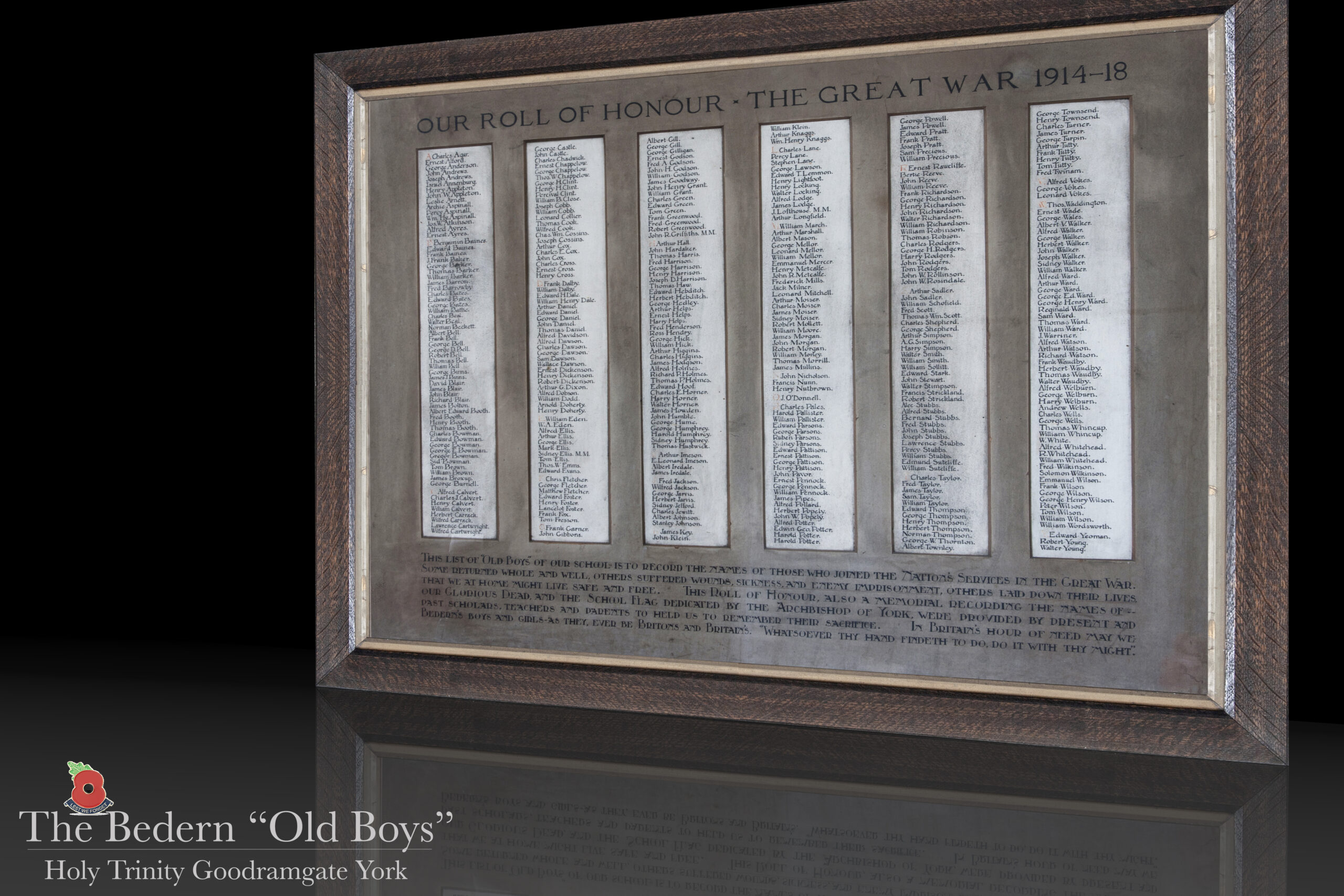
“Bedern Boys” 1914-18 memorial
-
Artefact photography
-
Church photography
English parish churches are the custodians of some of the world’s most outstanding works of art – stained glass, monuments, tiles, woodwork, furniture and the architecture itself, often dating back a thousand or more years. They can be treasure troves of artefacts of local, national and international significance. Promoting this to visitors is a way to keep our churches open, loved and most importantly, conserved and maintained. Visitor experience will always be enhanced by interpretation materials with high-quality imagery. I am an accomplished photographer specialising in historic buildings, mainly churches, their interiors, exteriors, details and landscape settings. I produce high-resolution digital imagery for prints, printed literature and digital publication. I…
-
St. Mary’s Chickney then and now
St. Mary’s church, Chickney, Essex, was struck by lightning on 3rd May 1902, causing extensive damage to the spire. A grand total of £329 was raised so repairs could be undertaken but the building suffered further neglect over the years. Further repairs were carried out in 1930 but eventually the cost of maintaining such an ancient building overcame the resources of the parish and in 1975 it was passed into the care of The Churches Conservation trust. Today, visitors can find this hidden marvel open daily and particularly atmospheric. Stonework in the walls predates the Norman Conquest and that of the medieval font is a delight. Slide the divider on…
-
Return of the Stainburn bible stand
Early in 2014 my attention was drawn to an inscribed brass ‘memorial plaque’ being sold in Belfast on a well-known auction website. The first to bring this to my attention was a vicar in Northamptonshire, who’d noticed that the words inscribed in the plaque mentioned ‘Stainburn’, a picturesque North Yorkshire village whose church fell within my guardianship as the Field Officer working for the owner of that historic building, The Churches Conservation Trust. Fortunately the astute vicar emailed the CCT without hesitation asking, “isn’t Stainburn one of yours?”. My eyebrows were raised. Surely if this memorial plaque belonged to St. Mary’s church in Stainburn, how had it ended up in…