Church Monuments
-
“Bedern Boys” 1914-18 memorial
The Bedern memorial board is a roll of honour for the “old boys” of Bedern School who went to fight in the Great War. Their names are in rubric indicating whether they returned, were injured, captured by the enemy, or were killed fighting for their country. The following is an example of some graphics that could be included in a project to raise necessary funds for conservation of the board and its lettering. The photos of the board were taken by this author between 2009 and 2016. I have digitally enhanced the frame to make the memorial more presentable for the photographs and video. A short video
You May Also Like

The de la Pole monumental brass
- Church Monuments, Churches, Heritage, Heritage Crime, History, Post-Medieval History, The Churches Conservation Trust
Badley’s missing shield
On 13th September 2019 the Suffolk Mercury newspaper reported that an historical stone shield with a value in the region of £1000 had been stolen from St. Mary’s church in Badley, Suffolk. The newspaper report claimed ‘The carved stone crest was taken from St Marys Church in Badley at some point between Saturday, June 1 and Saturday, September 7 [2019]‘. An identical article appeared on the same day in the Stowmarket Mercury and both coincided with a Tweet by The Churches Conservation Trust, the owner of St. Mary’s, lamenting the news. The appeal for information on the whereabouts of the shield and more importantly, the perpetrator of the theft, was…
-
The de la Pole monumental brass
at Holy Trinity, Chrishall, Essex A late-medieval brass set into the floor at the west end of the south aisle at Holy Trinity, Chrishall, Essex, commemorating John de la Pole (d. 1379) and his wife Joan Cobham. More here – https://chrishallessex.co.uk/joan-cobham-chrishall/ The Chrishall brass is not in its original position, probably a chantry chapel founded and funded by the de la Pole family. Chantries were dissolved in the sixteenth-century Reformation. In comparison, St. Mary’s church in Cobham, Kent, where Joan was born and grew up, provides the best evidence of the culture of commemorative monumental brasses in this period. The chancel floor is home to the best collection of memorial…
You May Also Like
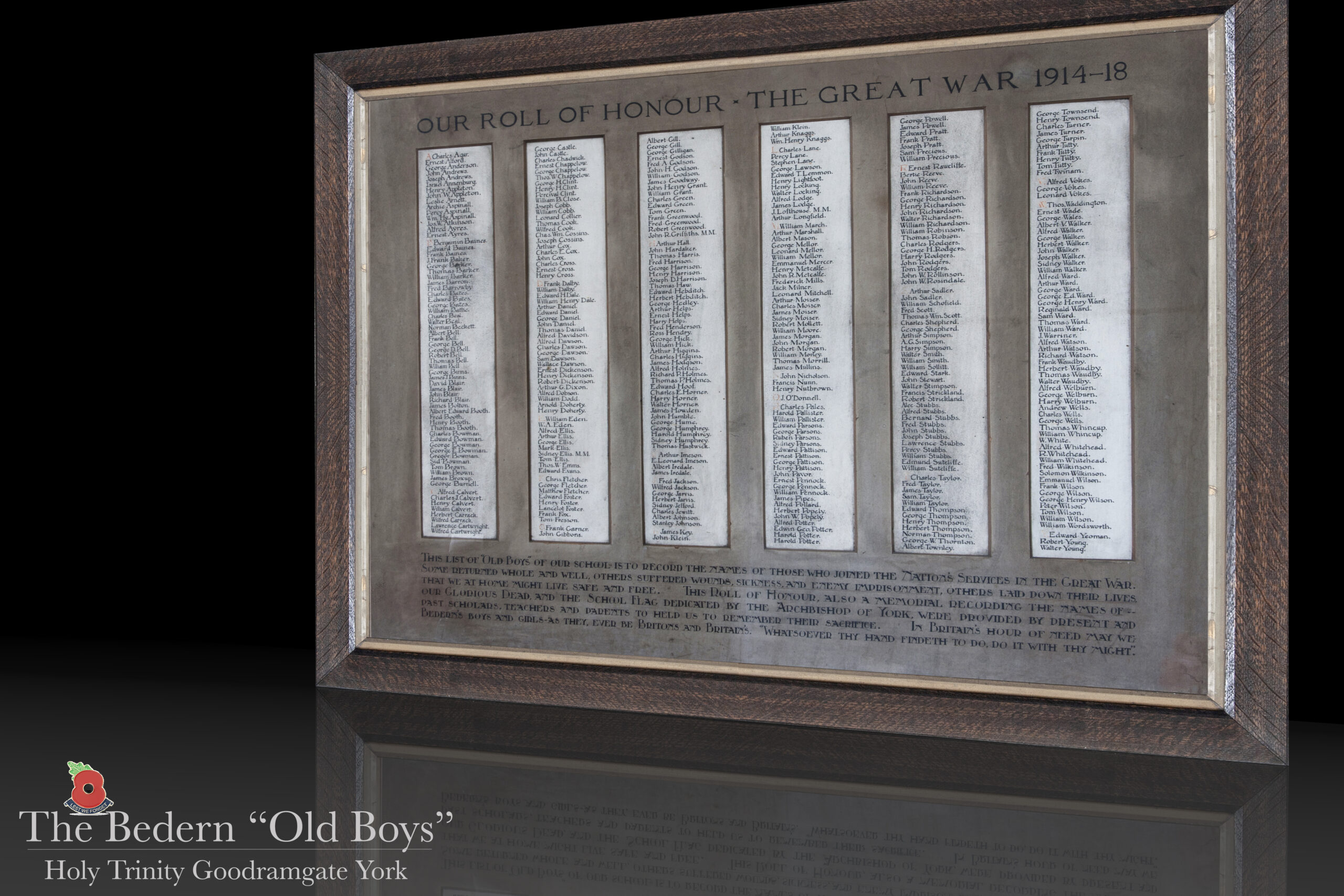
“Bedern Boys” 1914-18 memorial
-
Church photography
English parish churches are the custodians of some of the world’s most outstanding works of art – stained glass, monuments, tiles, woodwork, furniture and the architecture itself, often dating back a thousand or more years. They can be treasure troves of artefacts of local, national and international significance. Promoting this to visitors is a way to keep our churches open, loved and most importantly, conserved and maintained. Visitor experience will always be enhanced by interpretation materials with high-quality imagery. I am an accomplished photographer specialising in historic buildings, mainly churches, their interiors, exteriors, details and landscape settings. I produce high-resolution digital imagery for prints, printed literature and digital publication. I…
- Church Monuments, Churches, Heritage, History, Post-Medieval History, The Churches Conservation Trust
Henry Audley’s monument at Berechurch Essex
Henry Audley’s magnificent memorial stands in St. Michael’s Church, Berechurch, a mile or two south of Colchester in Essex. “His date of death is not known but, as he is known to have been alive in 1664, this monument, erected in 1648, took shape some years before he died. Flanked by flaming urns, his armour-clad effigy reclines on its side, looking out. His head rests upon his helmet and one of his gauntlets rests upon his sword. Beneath are the figures of his five children – Katherine, Marian, Abigail, Thomas and Henry, one of whom carries a skull, indicating that he had already died. Above is the Latin inscription, crowned…
- Church Monuments, Churches, Heritage, History, Post-Medieval History, The Churches Conservation Trust
William Burges’ rose window
The rose window high in the west end of the church of Christ the Consoler, Skelton-cum-Newby, dates to the mid 1870s and was made by Saunders & Co. to a design by Frederick Weekes. Christ the Consoler is shown enthroned in a central position in a mandorla presiding over representations of the stages of life on the inner circle and people from all over the world on the outer. This church was designed by William Burges (1827-1881) for Lady Mary Vyner, in memory of her son Frederick. He had been kidnapped by brigands in Greece during his Grand Tour and, aged only twenty-three years, murdered during a rescue attempt. Lady…
-
High Ambition, Low Elswick
St. Stephen’s tower, Low Elswick, is one of the most overlooked and rarely mentioned buildings in the CCT’s portfolio of historic churches, despite the local and international significance of those who built it. It remains a landmark for those travelling to and from Newcastle city centre towards the A1 and retains a ring of eight bells cast in 1880 by Taylor’s of Loughborough. Designed by local architect, R. J.Johnson, the foundation stone for St. Stephen’s church was laid on 19th November 1866 by Sir William Armstrong. Armstrong’s empire had flourished upon engineering brilliance, he having invented the hydraulic crane and the Armstrong breech-loading gun, both being watershed developments for heavy…
- Church Monuments, Churches, Heritage, Heritage Crime, History, Medieval History, The Churches Conservation Trust
The case of the Cowthorpe brass
19th-century metal theft The theft of antiquities from churches isn’t a new problem. On Saturday 9th June 1860, the York Herald reported on such a crime, with the headline, “Sacrilege at Cowthorpe”: “Within the last few days, the Parish Church of Cowthorpe, near Tadcaster, was entered by thieves, and the following property stolen : — A white metal flagon and basin, a pewter plate, and a quantity of brass from off the tomb of Brian Rowclyff, who founded the church in the year 1445. On one of the pieces of brass, a narrow plate, is engraven in Old English characters, a Latin inscription, and upon another brass plate, which is…


