Churches
- Church Monuments, Churches, Heritage, History, Post-Medieval History, The Churches Conservation Trust
Henry Audley’s monument at Berechurch Essex
Henry Audley’s magnificent memorial stands in St. Michael’s Church, Berechurch, a mile or two south of Colchester in Essex. “His date of death is not known but, as he is known to have been alive in 1664, this monument, erected in 1648, took shape some years before he died. Flanked by flaming urns, his armour-clad effigy reclines on its side, looking out. His head rests upon his helmet and one of his gauntlets rests upon his sword. Beneath are the figures of his five children – Katherine, Marian, Abigail, Thomas and Henry, one of whom carries a skull, indicating that he had already died. Above is the Latin inscription, crowned…
-
21st-Century Iconoclasm?
Heritage Crime… Little Cawthorpe, Lincolnshire, St. Helen’s Church The present church of St. Helen was constructed in 1859 to replace a medieval one, this being the third building on this site. Records indicate the earliest church was founded here in the 1100s. The stained glass in the present St. Helen’s, by Lavers, Barraud and Westlake, was installed between 1860 and 1890. The south windows depict Christ and the Doctors and the Presentation in the Temple. The impressive west window, donated by the inimitably named Lysimachus Parker, who died in 1860, shows Noah’s Ark, the Baptism of Christ and the Crossing of the Red Sea. In April 2021 the glass was…
- Church Monuments, Churches, Heritage, History, Post-Medieval History, The Churches Conservation Trust
William Burges’ rose window
The rose window high in the west end of the church of Christ the Consoler, Skelton-cum-Newby, dates to the mid 1870s and was made by Saunders & Co. to a design by Frederick Weekes. Christ the Consoler is shown enthroned in a central position in a mandorla presiding over representations of the stages of life on the inner circle and people from all over the world on the outer. This church was designed by William Burges (1827-1881) for Lady Mary Vyner, in memory of her son Frederick. He had been kidnapped by brigands in Greece during his Grand Tour and, aged only twenty-three years, murdered during a rescue attempt. Lady…
-
High Ambition, Low Elswick
St. Stephen’s tower, Low Elswick, is one of the most overlooked and rarely mentioned buildings in the CCT’s portfolio of historic churches, despite the local and international significance of those who built it. It remains a landmark for those travelling to and from Newcastle city centre towards the A1 and retains a ring of eight bells cast in 1880 by Taylor’s of Loughborough. Designed by local architect, R. J.Johnson, the foundation stone for St. Stephen’s church was laid on 19th November 1866 by Sir William Armstrong. Armstrong’s empire had flourished upon engineering brilliance, he having invented the hydraulic crane and the Armstrong breech-loading gun, both being watershed developments for heavy…
-
Knowing the numbers
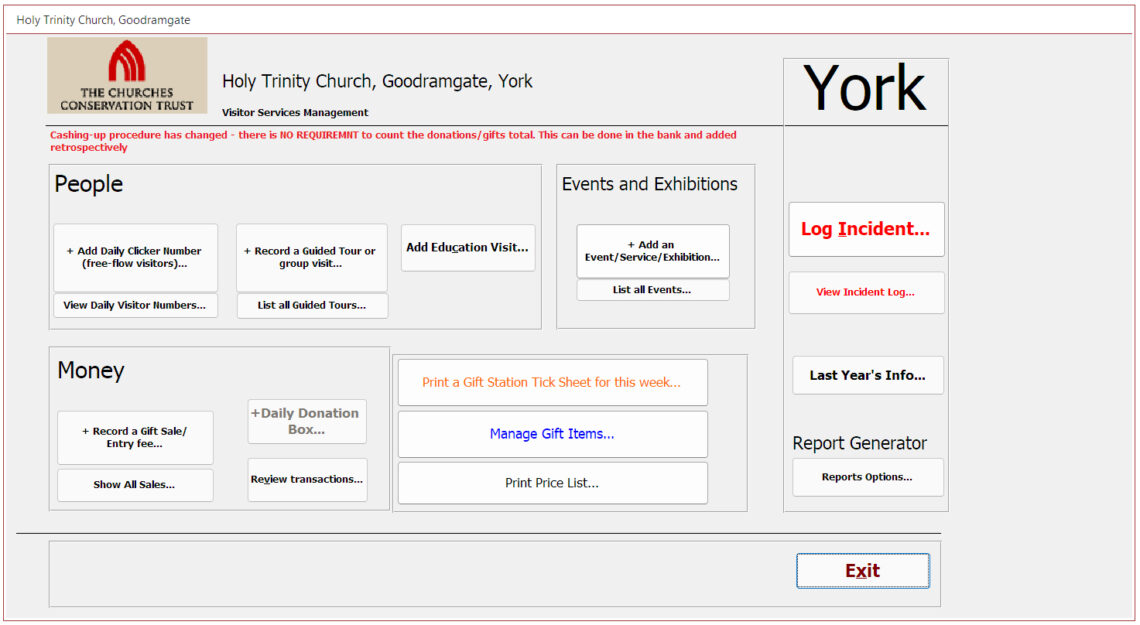
Historic-Church Administration System Posted on 9th December 2019 by Graham W Management information was essential when embarking upon the project to develop Holy Trinity Goodramgate into a world-class visitor attraction, leading to its status as Number 1 attraction in York on TripAdvisor within only a few years. Volunteers working on visitor-welcome duties could record invaluable information about those who came to the church. Volunteers cashed up the donations box daily, registered group visits, discerning between free-flow visitors, guide-led groups (fee-paying or otherwise), educational groups and pre-arranged visits. Retail sales in the small on-site gift-shop were also recorded, stock-control data being maintained by the program. It was invaluable for the accounting and banking of…
-
A high-tech visitor welcome
Early in 2018 I was presented with an operational problem. I had been asked to refresh the visitor notices at 107 historic sites in the ownership of The Churches Conservation Trust, no longer needed for services but historically significant and well-visited. Each site needed three separate notices. The first, to be displayed outside each church, advising visitors of opening hours, keyholder location (where the church was not already unlocked) and safety information – for example paths across churchyards can be slippery and uneven etc. The second, advising visitors of other churches within the organisation’s collection, which can be found nearby and the third being a welcome and safety notice to…
-
High ambition and Low-Elswick
St. Stephen’s tower, Low Elswick, is one of the most overlooked and rarely mentioned buildings in the CCT’s portfolio of historic churches, despite the local and international significance of those who built it. It remains a landmark for those travelling to and from Newcastle city centre towards the A1 and retains a ring of eight bells cast in 1880 by Taylor’s of Loughborough. Designed by local architect, R. J.Johnson, the foundation stone for St. Stephen’s church was laid on 19th November 1866 by Sir William Armstrong. Armstrong’s empire had flourished upon engineering brilliance, he having invented the hydraulic crane and the Armstrong breech-loading gun, both being watershed developments for heavy…
- Church Monuments, Churches, Heritage, Heritage Crime, History, Medieval History, The Churches Conservation Trust
The case of the Cowthorpe brass
19th-century metal theft The theft of antiquities from churches isn’t a new problem. On Saturday 9th June 1860, the York Herald reported on such a crime, with the headline, “Sacrilege at Cowthorpe”: “Within the last few days, the Parish Church of Cowthorpe, near Tadcaster, was entered by thieves, and the following property stolen : — A white metal flagon and basin, a pewter plate, and a quantity of brass from off the tomb of Brian Rowclyff, who founded the church in the year 1445. On one of the pieces of brass, a narrow plate, is engraven in Old English characters, a Latin inscription, and upon another brass plate, which is…